Foundations of Education

Foundations of Education

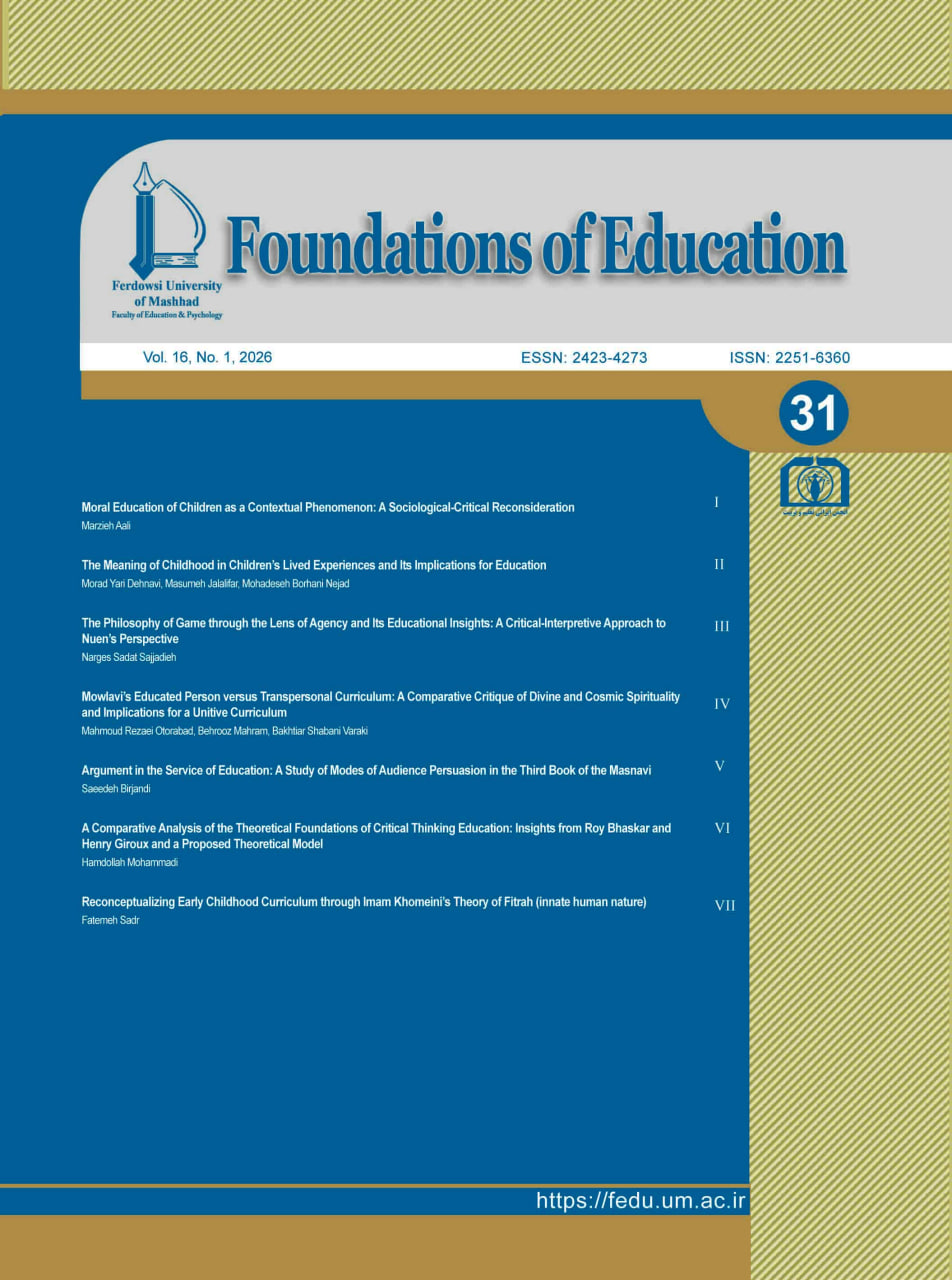
Mowlavi’s Educated Person versus Transpersonal Curriculum: A Comparative Critique of Divine and Cosmic Spirituality and Implications for a Unitive Curriculum

Document Type : پژوهشی

Authors
1 . Ph.D. Candidate in Curriculum Development, Ferdowsi University of Mashhad, Mashhad, Iran
2 Professor, Department of Curriculum Studies and Instruction, Ferdowsi University of Mashhad, Mashhad, Iran
3 Professor, Department of Foundations of Education, Faculty of Education and Psychology, Ferdowsi University of Mashhad, Mashhad, Iran
Abstract
Abstract
This study critically compares the transpersonal curriculum with Mawlana’s educational anthropology to explore the implications for developing an alternative spiritual curriculum. The central problem concerns two contrasting conceptions of spirituality: the transpersonal perspective, which approaches spirituality primarily through inner experience and psychological processes without necessarily grounding them in a determinate conception of divine reality, and Mawlana’s mystical perspective, which understands spirituality as an existential dimension rooted in the human relationship with divine truth and oriented toward proximity to God. Adopting a speculative and critical-comparative approach, the study examines the two frameworks along four dimensions: conceptions of spirituality, ontology, anthropology, and epistemology. The findings indicate that, within the transpersonal framework, the ideal person is conceived as a self-transcending subject with a fluid identity who participates in the construction and interpretation of spiritual reality. In contrast, Mawlana’s educated person (ensān-e farhīkhte) is conceived as a monotheistic wayfarer (sālek) whose formation involves four interconnected existential dimensions: loving being, integral consciousness, ethical integration, and compassionate presence. The fundamental contrast between these two frameworks concerns not transpersonal experience as such, but the curricular assumptions and structures through which spirituality is educationally articulated. From Mawlana’s perspective, a transpersonal curriculum that does not commit to a determinate monotheistic telos cannot adequately provide the conditions for cultivating the educated person as a monotheistic wayfarer. The study therefore proposes a Unitive Curriculum as an alternative spiritual curriculum, in which the overarching aim is spiritual wayfaring toward divine proximity. Its content, teaching and learning strategies, assessment, learning environment, and the roles of teacher and learner are derived from Mawlana’s educational anthropology, particularly his conception of the wayfarer and the four dimensions of the educated person. This alternative curriculum is organized around a hermeneutical-spiritual arc, which serves as the integrating principle of the educational process and connects its aims, content, pedagogical practices, and forms of evaluation.
Synopsis
Modern education, after a long period dominated by secularism and by classical models centered on cognitive and skill-based outcomes, faces an existential and semantic crisis. Holistic education and spiritual curricula have emerged in response, and the transpersonal curriculum is among the most influential; it seeks educational spaces oriented toward meaning, purpose, and existential transcendence (Esbjorn-Hargens et al., 2010; Miller, 2000). The foundational question is how spirituality is defined in this curriculum and on which ontological, anthropological, and epistemological foundations it rests. This study argues that the transpersonal approach reduces spirituality to inner experiences and psychological functions severed from divine foundations, whereas in Mowlavi's (Mawlana Rumi's) mysticism spirituality is an existential dimension rooted in the human relation to divine truth and oriented toward proximity to God (qurb). It asks what limitations the transpersonal foundations pose for educating the "educated person" (ensān-e farhīkhte) as Mowlavi conceives of it, and it draws on Mowlavi's epistemic resources to design an alternative spiritual curriculum. The closest earlier study built a religion-and-life curriculum on the transpersonal framework without critiquing its ontological compatibility with monotheistic anthropology; this study places that critique first. Following Peters (1966), the educated person is derived analytically from within a determinate tradition, without claiming a binding definition.
The research is speculative and comparative-critical, and proceeded in two steps. First, the two systems were conceptually formulated. Document analysis (Bowen, 2009) served as an independent stage for selecting and validating sources by Scott's criteria of authenticity, credibility, representativeness, and meaningfulness. For Mowlavi, the six books of the Masnavi in Nicholson's edition were the primary document, supplemented by Karim Zamani's commentary; for the transpersonal approach, foundational texts and the independent curriculum literature were used (Rowe & Braud, 2013; Ferrer, Romero, & Albareda, 2005; Kessler, 2000; Miller, 2000). Inductive conceptual content analysis (Krippendorff, 2018; Weber, 1990), through open coding, axial categorization, and abstraction (Elo & Kyngäs, 2008), extracted the ontological, anthropological, and epistemological foundations, while the Masnavi was read hermeneutically, with Gadamer and Ricoeur, to reconstruct a coherent character from dispersed anecdotes. Second, the systems were compared and critiqued along four axes—conception of spirituality, ontology, anthropology, and epistemology—and implications for an alternative curriculum were derived deductively. Validity rested on authentic texts and expert peer review. The authors declare an explicitly normative, monotheistic stance and acknowledge limits, such as the "Americanized Rumi" phenomenon.
The transpersonal curriculum draws on James's radical empiricism, Jungian and Assagiolian psychology, and the participatory turn. Its ontology is participatory holism: the subject–object divide dissolves, spiritual reality is co-created in the interaction of person and world, and God or the Absolute is identified with the totality of being. Its ideal person is a fluid, self-transcending consciousness who, through peak experiences, moves beyond individual identity; the aim is self-transcendence, not self-actualization, and knowledge is validated by experiential depth and coherence.
Mowlavi's ontology is explicitly divine. Existential monotheism (tawhīd-e vojūdī) means not incarnation but the wayfarer's annihilation (fanā') in, and subsistence (baqā') through, God, within a hierarchy of being and a purposeful world. Partial reason, bound to carnal desires, cannot discern truth; universal reason connects the human being to perfect reason, and true knowledge comes from monotheistic intuition, inner purification, and the move from imitation to verification. The educated person is a monotheistic wayfarer (sālek) defined by four interconnected dimensions—loving being, integral consciousness, ethical integration, and compassionate presence—manifestations of one identity rather than scattered virtues.
The comparison shows opposition on all four axes: experience and function versus existential relation to sacred truth; participatory holism versus monotheistic ontology; an endless, self-transcending subject versus a directed wayfarer; and an immanent criterion of efficacy versus a transcendent criterion of correspondence with independent truth. The opposition concerns not transpersonal experience itself but the curricular apparatus built upon it. Given the mystical distinction between state (ḥāl) and station (maqām), such experience may at most be a bridge; a curriculum that refuses a determinate end mistakes the bridge for the destination and is therefore insufficient for educating Mowlavi's educated person.
Because the educated person is a being in becoming, the alternative is not linear and Tylerian but a path of wayfaring grounded in the hermeneutical-spiritual arc, with eight elements derived from Klein's classification. Aims: proximity to God, love-based motivation, existential sincerity, merciful justice. Content: servitude, contentment, submission, annihilation, subsistence, universal reason, self-purification. Competencies: persistent seeking, resilient contentment, sincerity in action, integrative insight. Strategies: guided philosophical dialogue, collective spiritual experience, monotheistically redefined mindfulness, teaching through action and metaphor, gardening. Assessment: seeking as the main indicator, growth "from crescent to full moon," continuous and mirror-like evaluation. Environment: garden-like, combining the fire of challenge and the water of care. Roles: the teacher as lover, physician, and mirror; the learner as seeker, patient, and self-accountable researcher.
Conclusion
Despite moving beyond purely cognitive and skill-based approaches, the transpersonal curriculum results from a rupture with ontological foundations and yields a functional spirituality and an anthropology without a transcendent end. Mowlavi's thought offers a coherent, operational alternative whose four dimensions support an integrated curriculum rather than separate courses in ethics, religion, and life skills. The model addresses a gap in Iran's Document of Fundamental Transformation of Education, whose aim of a monotheistic, truth-seeking person has largely remained at the level of ideals, and is proposed as a complement, not a replacement, in non-governmental schools, teacher education, and elective higher-education units. It is a theoretical framework rather than a prescription; implementation requires institutional mediations, such as redesigning teacher practicums around the teacher roles and pilot testing, followed by qualitative and experimental studies. No revision of content, strategy, or assessment succeeds without transforming the teacher's existential quality—from a source of knowledge to an exemplar of the educated person.
Keywords
Subjects

Andrade, A. A., & Fernández, N. M. (2006). Educación Transpersonal: Paradigma emergente en la educación e innovador en el currículo. Encuentro Educacional13(1), 86-100.
Amimkhandaghi, M., & Eslamiyan, Z. (2018). Against a Spiritual Humanity-Oriented Curriculum: a Review of Miller’s Positions Based on Murteza Mutahhari’s Views. Journal of Islamic Education13(27), 59-29. 10.30471/edu.2018.1463 (In Persian)
Azadibougar, O., & Patton, S. (2015). Coleman Barks' versions of Rumi in the USA. Translation and Literature24(2), 172-189. https://doi.org/10.3366/tal.2015.0200
Bahrami Qasr Chami ,Kh. (2016). The educated person from the Perspective of Ibn Arabi and Rumi , Journal of Mysticism 8 (15): 50-18  http://erfanmag.ir/article-1-411-fa.html (In Persian)
Biesta, G. J. (2015). Good education in an age of measurement: Ethics, politics, democracy. Routledge.
Bowen GA (2009), "Document Analysis as a Qualitative Research Method". Qualitative Research Journal, Vol. 9 No. 2 pp. 27–40, doi: https://doi.org/10.3316/QRJ0902027
Buckler, S. (2018). Transpersonal education: An evaluation of the current context from an international perspective. Transpersonal Psychology Review20(1).
Buckler, S., & Moore, H. (2025). Transpersonal education: A glimmer of light to compulsory education?. International Journal of Transpersonal Studies, 44 (1). https://doi.org/10.24972/ijts.2025.44.1.52
Creswell, J. W., & Poth, C. N. (2018). Qualitative inquiry and research design: Choosing                               among five approaches (4th ed.). Sage.
Cunningham, P. F. (2006). Transpersonal education: Problems, prospects and challenges. International Journal of Transpersonal Studies25(1), 6. http://dx.doi.org/10.24972/ijts.2006.25.1.62
Daniels, M. (2013). Traditional roots, history, and evolution of the transpersonal perspective. The Wiley‐Blackwell handbook of transpersonal psychology, 23-43.
Esbjorn-Hargens, S., Reams, J., & Gunnlaugson, O. (Eds.). (2010). Integral education: New directions for higher learning. State University of New York Press.
Elo, S. and Kyngäs, H. (2008), The qualitative content analysis process. Journal of Advanced Nursing, 62: 107-115. https://doi.org/10.1111/j.1365-2648.2007.04569.x
Fathi Vajargah, K. (2019). Fundamentals and Principles of Evaluation in Curriculum Planning. Tehran: Samt Publications. (In Persian)
Ferrer, J. N. (2008). Spiritual knowing as participatory enaction: An answer to the question of religious pluralism.
Ferrer, J. N. (2001). Revisioning transpersonal theory: A participatory vision of human spirituality. State University of New York Press.
Ferrer, J. N., Romero, M. T., & Albareda, R. V. (2005). Integral transformative education: A participatory proposal. Journal of Transformative Education3(4), 306-330.
Frankl, V. E. (1985). Man's search for meaning. Washington Square Press.
Hartelius, G., & Ferrer, J. N. (2013). Transpersonal philosophy: The participatory turn. The Wiley‐Blackwell handbook of transpersonal psychology, 187-202.
Hujwiri, A. A. (2004). Kashf al-Maḥjub (M. Abedi, Ed.). Soroush.
Helminiak, D. A. (2008). Spirituality for our global community: Beyond traditional religion to a world at peace. Bloomsbury Publishing USA.
Hirst, P. H., & White, P. (2006). Philosophy of education: Main themes in the analytic tradition (B. Shabani Varaki & M. R. Shoja Razavi, Trans.). Ferdowsi University of Mashhad Press. (In Persian)
Huebner, D. E. (1999). The lure of the transcendent: Collected essays by Dwayne E. Huebner. Psychology Press.
Javadi-Amoli, A. (2020). Human expectations of religion. Nashr-e Esra. (In Persian)
Kazemi, M., & Mirbagherifard, S. A. A. (2023). Analysis and Comparative Study of Anthropology in the Views of Molavi and Ibn Arabi. Religions and Mysticism Magazine, 56(1), 75–94. https://doi.org/10.22059/jrm.2023.355381.630424 (In Persian)
Kessler, R. (2000). The soul of education: Helping students find connection, compassion, and character at school. AscD.
Klein, M. F. (1991). The Politics of Curriculum Decision Making: Issues in Centralizing the Curriculum. State University of New York Press.
Krippendorff, K. (2018). Content analysis: An introduction to its methodology. Sage publications.
Lewis, F. D. (2014). Rumi-past and present, east and west: The life, teachings, and poetry of           Jalâl Al-Din Rumi. Simon and Schuster.
MacIntyre, A. (2007). After virtue: A study in moral theory. University of Notre Dame Pess.
Maslow, A. H. (1969). Various meanings of transcendence. Journal of Transpersonal Psychology, 1(1), 56-66. https://www.atpweb.org/jtparchive/trps-01-69-01-056.pdf
MacDonald, D. A. (2013). Philosophical underpinnings of transpersonal psychology as a science. The Wiley‐Blackwell Handbook of Transpersonal Psychology, 312-329.
Miller, J. P. (2000). Education and the soul: Toward a spiritual curriculum. State University of New York Press.
Mir, M. and shamshiri, B. (2015). The Study of Anthropology of Islamic mysticism and its implications in the citizenship education. Journal of New Thoughts on Education11(3), 135-154https://doi.org/10.22051/jontoe.2015.2087
Mirdamadi, S. M. H. and Emame Jomee, M. (2024). Investigating the Impact of Transcendent Philosophy and Mullā Ṣadrā's Thoughts on Jurisprudence (tafaqquh). Essays in Philosophy and Kalam55(2), 223-245. https://doi.org/10.22067/epk.2023.71809.1054
 
Mirzakhan, N., & Amin-Khandaqi, M. (2024). Spiritual Curriculum from the Perspective of Dwayne Huebner: From Thematic Shift to Pluralism. Journal of Islamic Education19(49),85-107.https://doi.org/10.30471/edu.2024.9380.2767 (In Persian)
Mohammadi,M , Faqihi,A , Rezaei,M H and Sarvar Yaghobi,A . (2021). Analysis and Comparison of the Epistemological Style of Education from the Point of View of Mowlavi and Critical Theorists. Islamic lifestyle with a focus on health5(12), 243-251. (In Persian)
Mowlavi, J. a.-D. M. (1999). Masnavi-ye Ma'navi [The Masnavi] (R. Nicholson, Ed.). Tahouri. (In Persian)
Peters, R.S. (1966). Ethics and Education (Routledge Revivals) (1st ed.). Routledge.          https://doi.org/10.4324/9781315712383
Pinar, W. F. (2011). What is curriculum theory? (2nd ed.). Routledge.
Rahman, F. (1975). The Philosophy of Mullā Ṣadrā (Ṣadr al-Dīn al-Shirāzī). Suny Press.
Ricoeur, P. (1992). Oneself as another. University of Chicago press.
Rizvi, S. (2019). Mulla Sadra. In E. N. Zalta (Ed.) , The Stanford Encyclopedia of Philosophy.
Rorty, R. (1984). The historiography of philosophy: four genres. Philosophy in history: Essays on the historiography of philosophy, 49-75.
Rowe, N., & Braud, W. (2013). Transpersonal education. The Wiley‐Blackwell handbook of transpersonal psychology, 666-686.
Rustom, M. (2012). The triumph of mercy: Philosophy and scripture in Mullā Ṣadrā. SUNY Press.
Rychen, D. S., & Salganik, L. H. (Eds.). (2003). Key Competencies for a Successful Life and a Well-Functioning Society. Göttingen, Germany: Hogrefe & Huber Publishers.
Sajadi, S. J. (2022). Farhang-e estelahat va ta'birat-e erfani [Dictionary of mystical terms               and expressions]. Tahouri. (In Persian)
Scott, J. (2014). A matter of record: Documentary sources in social research. John Wiley & Sons.
Shamshiri, B., & Fereydouni, Z. (2014). The concept of self from the perspective of          humanistic psychology and Islamic mysticism with an emphasis on the comparative          method. Psychological Methods and Models, 4(16). 65-84.                                                      https://dorl.net/dor/20.1001.1.22285516.1393.4.16.5.4
Sohbatlu, A., Ahanghian, H. R., Shabani Varaki, B., & Sadeghzadeh Ghamsari, A. (2016).               Critique of the philosophical foundations of Iran's education regarding the educated               person based on Avicenna's viewpoint. Journal of the Faculty of Educational          Sciences and Psychology, Ferdowsi University of Mashhad. (In Persian)
Supreme Council of Cultural Revolution. (2011). Document of Fundamental Transformation of Education in the Islamic Republic of Iran. (In Persian)
Taylor, C. (2007). A secular age. Harvard university press.
https://doi.org/10.4159/9780674044289
Vaughan, F. (1982). The transpersonal perspective: A personal overview. Journal of Transpersonal Psychology14(1), 37-45.
Walach, H. (2013). Criticisms of transpersonal psychology and beyond—the future of transpersonal psychology: A science and culture of consciousness. The Wiley‐Blackwell Handbook of Transpersonal Psychology, 62-87.
Walsh, R., & Vaughan, F. (1993). On transpersonal definitions. Journal of Transpersonal Psychology, 25(2), 199–207.
Weber, R. P. (1990). Basic content analysis (Vol. 49). Sage.
Wilber, K. (1993). The spectrum of consciousness. Quest books.
Wilber, K. (2001). A theory of everything: An integral vision for business, politics, science and spirituality. Shambhala publications.
Zarrinkoob, A. (1990). A Search in Iranian Sufism. Tehran: Amirkabir. (In Persian)
Send comment about this article
Enter Name.
Enter a valid email address.
Enter a vaid affiliation.
Enter comments (At leaset 10 words)
CAPTCHA Image
Enter Security Code Correctly.
Volume 16, Issue 1 - Serial Number 31
September 2026
Pages 74-106

  • Receive Date 22 July 2026
  • Revise Date 22 August 2026
  • Accept Date 19 September 2026