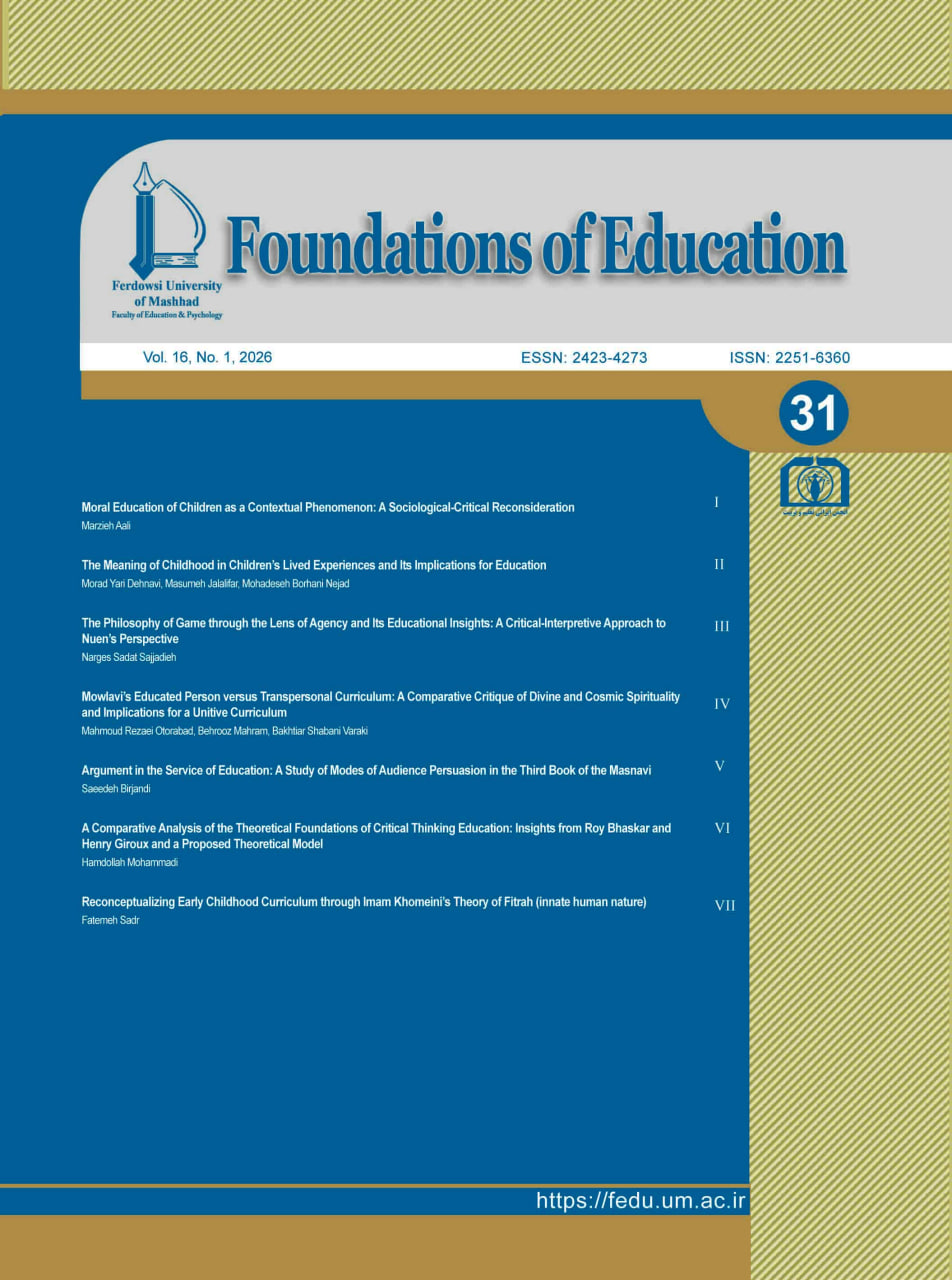
Foundations of Education

Foundations of Education

Argument in the Service of Education: A Study of Modes of Audience Persuasion in the Third Book of the Masnavi

Document Type : پژوهشی

Author
Assistant Professor, Department of Persian Language Literature Education, Farhangian University, Tehran, Iran
Abstract
Abstract
Persuasion in mystical literature is not limited to securing an audience’s acceptance of a proposition; rather, it may function as part of a pedagogical process in which cognition, emotion, credibility, and readiness for action interact. This study examines Mowlavi’s persuasive techniques in Book Three of the Masnavi in relation to ethical and spiritual education. Moving beyond a simple rational–emotional dichotomy, the analysis employs the interplay of logos, pathos, and ethos as its primary analytical framework. Religious references are examined separately as scriptural warrants rather than being automatically classified as forms of rational argument. The study adopts a qualitative directed content-analysis approach. The research population comprises the entirety of Book Three of the Masnavi, consisting of 4,810 couplets according to the Nicholson-based count. The couplet constitutes the primary unit of analysis, while the story or narrative section serves as the contextual unit. The analysis indicates that storytelling, allegory, simile, Qur’anic and hadith-based references, proverbs and maxims, advice, repetition, allusion, and indirect expression generally operate in combination rather than in isolation. Allegory becomes persuasive by rendering abstract propositions experientially accessible; storytelling facilitates identification and enables audiences to encounter the consequences of moral choices indirectly; and scriptural references reinforce normative legitimacy. The study thus contributes not merely by identifying persuasive devices, but by demonstrating how their combination can constitute a pedagogical process of persuasion through which audiences may move from understanding to evaluation, acceptance, and readiness for action.
Synopsis
Persuasion is one of the important topics in the field of communication, and humans, as social beings, inevitably, willingly or unwillingly, use various methods to persuade their audience in their relationships with others. Mystics have also paid attention to persuading the audience in their works and speeches, because guiding people and solving their problems has been the concern of many mystics. For this purpose, they have used methods and techniques to better influence the mind and psyche of the audience. Among these mystics, Rumi can be mentioned in his famous mystical work, "The Spiritual Mathnavi". The present article examines the methods that Rumi used to influence his audience in terms of education using a qualitative (analytical-descriptive) method (Amirkaveh and Eslami, 2016: 175).
For this purpose, Rumi's moral and educational teachings in the third book of the spiritual Masnavi were examined, and then the persuasive methods he used in teaching issues that have an educational approach were examined.
The spiritual Masnavi is one of the masterpieces of Persian literature and one of the masterpieces of mystical works. This book is full of mystical and educational teachings that Rumi composed to guide and educate his audience (all humans). Throughout this work, Rumi has tried to influence his audience as much as possible, and for this purpose, he has used various methods such as allegory, storytelling, verses, and narrations.
The research method in this article is analytical-descriptive. To gather the evidence, examples, and required materials, the third book of the Masnavi was carefully studied.
To persuade and convince his audience and teach them educational issues and matters, Rumi used various methods, such as repetition, advice, storytelling, using verses from the Quran, allusion, parable, irony, simile, and reasoning, which are discussed in this article. But what is noteworthy is that he himself has mentioned that giving advice and conveying the message to the audience is his mission (Maulana, 1939: 10). In this way, he has introduced his goal and duty as informing people and their happiness; therefore, it is quite logical that he uses certain techniques to convince the audience and make his words effective.
Conclusion
In this article, after examining Rumi's persuasive methods in the third book of the spiritual Masnavi with an educational approach, the following results were obtained: Rumi used various literary and verbal methods to persuade his audience educationally. He used parables and storytelling the most. In this way, almost the entire Masnavi, and especially its third book, is full of stories and parables that the poet has used to consolidate his concepts in the minds of his audience. After the parables, he also has some advice and recommendations for his audience and has tried to instill them in the audience with a fatherly and teacher-like language. Also, in Rumi's verses, a large number of Quranic verses can be seen. Rumi sometimes used the exact verses and sometimes translated or explained their meaning. Rumi also made extensive use of Persian and Arabic proverbs and sayings in his poems. The poet paid great attention to the reasonableness of the concepts and meanings of his words; for this reason, after mentioning the concepts and meanings, he also provided arguments to strengthen them. The use of literary devices such as alliteration, simile, and irony were other methods used by Rumi in the third book of the spiritual Masnavi to convince his audience.
Keywords
Subjects

The Holy Quran
Afzalnia, B, Etehadi, H, Salari, M, (1402), The art of using persuasive techniques in the spiritual Masnavi (sixth book), Theology of Art, No. 24, pp. 263-284.
 
Amirkaveh, S. & Eslami, Sh., (2016), The method of persuading the audience in Nahjul-Balagha, Journal of Islamic Social Research, No. 110, pp. 175-214.
Dehkhoda, A.A, (1966), Dictionary, University of Tehran, Tehran.
Dowlatdoost, H.& Nasrabadi, Hassanali B.& Heydari, M.H. & Mohammadi Fasharaki, M., (2019), Analysis of the educational implications of contentment in the spiritual Masnavi, Modern Educational Thoughts, Vol. 15, No. 4, pp. 95-120.
Eliasi, MH. & Ashayeri, H.& Chiraghi, Gh, (2008), The relationship between the use of persuasion techniques and the morale of the personnel of the Greater Tehran Special Unit for Intervention in Crisis, Law Enforcement Studies, Year 3, No. 4, pp. 416-436.
Eliasi, MH., (2009), Theoretical and Practical Foundations of Persuasion and Persuasion, Basij Strategic Studies, Vol. 45, pp. 41-72.
Fathollahi, I. & Kameli, I. (2015), The Process of Persuasion in the Holy Quran, Research in the Sciences of the Quran and Hadith, Vol. 25, pp. 75-99.
Foroughi, MH. & Ghasemi, Sh. (2014), The Role of the Teacher in Religious Education from the Perspective of Rumi in the Masnavi, National Conference of the Iranian Society for the Philosophy of Education, pp. 81-84.
saadati, A, shajari, R (2010), Rumi's Approach to Reasoning, Mystical Literature, Volume 1, No. 2, pp. 125-150.
 
Habibi, H.& Shahanganian, N., (2016), Study of the concept of salvation in Rumi's Masnavi, Studies in Literature, Mysticism and Philosophy, Vol. 1/2, pp. 545-559.
Hajveiri, A. (2014), The Discovery of the Obscured, edited by Fereydoun Asyabi Eshghi Zanjani, Tabyan, Qom.
Halimi-Julodar, H.& Patyar, E., (2015), The Purpose of Persuasion in Education with Emphasis on the Story of Prophet Abraham in the Holy Quran, Quranic Studies, Volume 5,
Homaei, J. (2010), The Techniques of Rhetoric and Literary Crafts, Scientific, Tehran.
Jalaluddin Rumi, Mathnawi Manavi, (1929), Third and Fourth Editions, edited by Nicholson, Reynold Lane, Berlin.
Karampour, Z. & Hassumi, V. & Khakpour, Hossein, (2015), Persuasion of the Audience in Nahj al-Balagha, Nahj al-Balagha Journal, Vol. 9, 2: 27-54.
Mah-Nazari, (2019), The Role of Allegory in the Stories of the Spiritual Masnavi, Literary Arts, Vol. 6, Vol. 2, pp. 133-146.
Maydani, A. (1989), Majma’ al-Mahja’ al-Mahfa’l, Dar al-Muktabah al-Hayyah, Beirut.
Mayel-Heravi, N. & Vali-Mohammad, Akbarabadi, 2008, Explanation of Rumi's Masnavi, known as the Makhzan al-Asrar, Volume 3, Qatra Publishing House, Tehran.
Moradi, H. (2005), Persuasion and Social Communication, Vol. 2, Tehran, Saqi Publishing House.
Motawali, K. (2005), Public Opinion and Methods of Persuasion, Vol. 1, Bahjat Publishing House, Tehran.
Mousavi, S. & Mirzaei, M. (2018), Studying the sentence "Attaq shir man ahsanat aliyyah" in terms of its origin and its conceptual comparison with religious teachings, Hadith teachings, Vol. 14, pp. 27-44.
Muezzin, A. & Ahmadi. M. (2014), An Introduction to the Place of the Persuasion Process in the Art of Oratory and Literary Studies, Vol. 9, pp. 93-112.
Nahj al-Balagha, (2003), Translated by Mohammad Dashti, Qom, Bakhshaysh Publications.
Nahvi, A. & Dehghani, N. (2010), A Study of the Structure of the Text in Kashf al-Mahjoob al-Hajweeri, Bostan Adab Magazine, Year 2, Vol. 6, pp. 147-171.
Safa’inejad, Q. (2015), Persuasion theories and their application in the media, Media Management, Vol. 12, pp. 23-38.
Sayadinejad, R. & Amiri, Sh. & ; Zakai, A (2018), Mutanabi's Linguistic Techniques in Persuasion from the Perspective of Pragmatism, Vol. 18, pp. 119-147.
Shaker, M. (2018), Persuading the audience in Hadiqa Sana'i by arguing with verses and hadiths, History and Literature Journal, No. 82, pp. 83-112.
Zarei, M. & Rashidi, F. (2016), A study of the myth of Harut and Marut in the spiritual Masnavi, Mysticism in Persian Literature, Vol. 27, pp. 73-89.
Zarkoub, M. & Abdollahi, Z. (2010), Allegory in Persian and Arabic Proverbs, Gohar Goya, Year 4, No. 3, pp. 109-136.
Send comment about this article
Enter Name.
Enter a valid email address.
Enter a vaid affiliation.
Enter comments (At leaset 10 words)
CAPTCHA Image
Enter Security Code Correctly.
Volume 16, Issue 1 - Serial Number 31
September 2026
Pages 107-129

  • Receive Date 15 December 2025
  • Revise Date 08 September 2026
  • Accept Date 21 September 2026