Foundations of Education

Foundations of Education

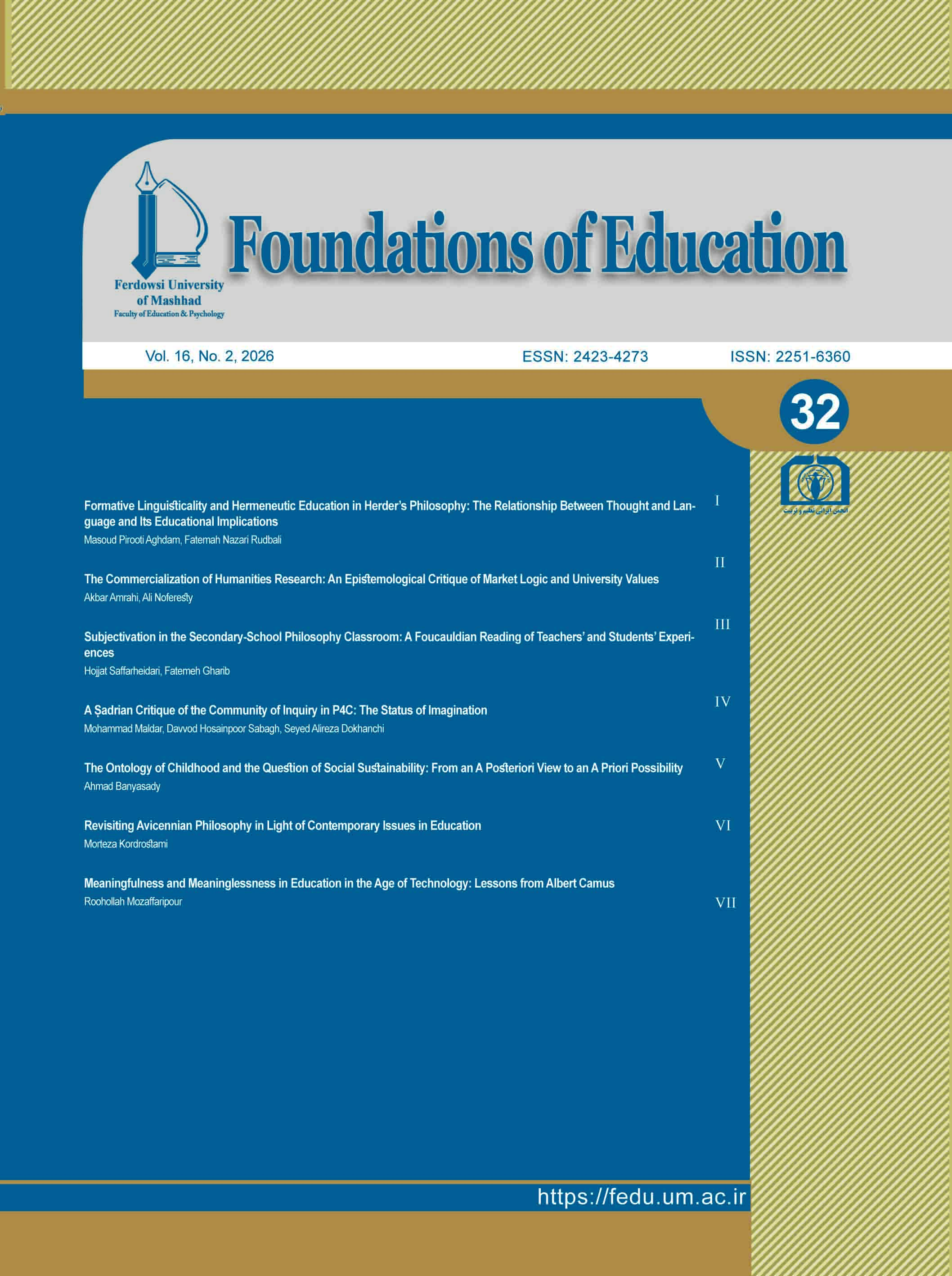
The Ontology of Childhood and the Question of Social Sustainability: From an A Posteriori View to an A Priori Possibility

Document Type : پژوهشی

Author
Assistant Professor, Department of Educational Sciences, Faculty of Literature and Humanities, Malayer University, Malayer, Iran.
Abstract
Abstract
Prevailing discourses on understanding and educating the child tend to view the child mainly through psychological-developmental, legal, or skills-based approaches; approaches that regard the child as a “deficient” and “still developing” being and define the aim of education as bringing the child to a desirable state in adulthood. Examining the relationship between childhood and social sustainability, this article revisits the common “a posteriori” view of social sustainability, which treats it as an external, future-oriented state to be attained, and explores the possibility of an “a priori” view: one that understands sustainability as an ontological matter rooted in human beings’ mode of being in the world. The central argument is that the ontology of childhood is not a marginal topic but a gateway to thinking about social sustainability; not in the sense that children should be educated for a future sustainability, but in the sense that the child’s mode of being, as a being who simultaneously “is” and “becomes,” already lives a form of sustainability here and now. Drawing on the contested literature on “being” and “becoming” in childhood studies, and critiquing the prevailing educational discourse that views the child largely through deficiency, the article shows that the relationship between childhood and social sustainability is not merely instrumental and temporal. The educational implications of this rethinking are formulated not as new prescriptions but as a shift in the quality of the educator’s presence alongside the child, from “compensating for a deficiency” to “making room for the child’s emergence,” and as a distinct understanding of childhood among parents. The study adopts critical reflection as its method and does not seek to advance a definitive claim; rather, it seeks to open a theoretical possibility for rethinking the relationship between the ontology of childhood and social sustainability.
Synopsis
This article examines the relationship between childhood and social sustainability by asking where sustainability originates. In Iran, as elsewhere, social sustainability has become a major concern for policymakers and researchers, yet studies in Tehran, Zahedan, Ilam Province, and other settings continue to report low sustainability and persistent educational inequality. Most of these studies, and the major conceptual frameworks in the field (Eizenberg and Jabareen, 2017; Vallance, Perkins, and Dixon, 2011; Åhman, 2013), treat sustainability as an external state, measured by indicators and attained in the future. The article calls this the “a posteriori” view. Even the studies closest to this claim, such as Lecusay and colleagues’ view of sustainability as an ecology of caring practices, reach their conclusions by analyzing practice, and systematic reviews show the field is organized around policies and programs, not theoretical foundations explaining why childhood should be a site of reflection. Its central question is whether the limited yield of the a posteriori view points to a deeper, ontological layer: an “a priori” possibility in which sustainability is rooted in the human mode of being in the world.
Methodologically, the study is a theoretical inquiry based on critical reflection (Fook,2025; Morley, 2008). Texts from the literature on childhood studies and social sustainability were purposively selected for their link to the tension between “being” and “becoming” or to an ontological redefinition of sustainability. They were analyzed in three steps following the DEAL model (Describe, Examine, Articulate Learning). Each text was read on its own terms; the texts were compared in light of the guiding question, and an ontological formulation and its educational implications were drawn out. Validity rests on the transparency and coherence of the interpretive reasoning, the fair representation of alternative views, and the researcher’s explicit reflection on their assumptions, not on statistical tests. The study makes no definitive claim; it aims to open a theoretical possibility.
The first finding concerns the dominant discourses on childhood: the psychological-developmental, the sociological-legal (e.g., Lundy’s participation model,2007), and the skills-based (e.g., the OECD Learning Compass 2030). Despite their differences, all define the child as “deficient” and “still developing,” whether psychologically, legally, or in terms of competence, and thus define the child only in relation to adulthood (James and Prout,1990). A limited review of Iranian upstream documents suggests that the same logic prevails there, although this judgment is preliminary. Such approaches reproduce the a posteriori logic: qualities such as cooperation and responsibility are transmitted as external skills, not lived by the child.
The second finding is that the child can be understood as simultaneously “being” and “becoming” (Uprichard,2008). Taking the child’s present seriously is the condition for a desirable future, not a means to it. This leads to rethinking being as both necessary and dynamic. Drawing on a general insight from Heidegger’s being-in-the-world, and on resonances with Takkinen, Pulkki, and Vadén, the article suggests that human existence is relational from the outset. If sustainability is the quality of this relation, it cannot be imposed from outside. The third finding follows: childhood is not an instrument for achieving sustainability, but the place where sustainability is already lived, and it cannot be postponed to adulthood.
Conclusion
The educational implications are formulated not as new prescriptions but as a change in the quality of the educator’s presence. Drawing on Arendt’s notion of natality and Biesta’s critique of “learnification,” the educator’s task shifts from “compensating for a deficiency” to “making room for the child’s emergence,” recognizing the child as someone who appears and not as something to be shaped. This resembles a Socratic, midwife-like role. The teacher accompanies the child’s own questions, for example about a leaf’s shape or a plant’s need for water, deepening and orienting them without imposing values. The same logic extends from the child’s encounter with a phenomenon, to a dispute over sharing, to collective decisions about a shared space. Sustainability grows from “I and the other,” then “I and others,” not from external rules. Planting, cooperative games, and environmental storytelling can serve as settings for this ontological dialogue. Parents’ views of childhood, largely shaped by market-driven and competence-oriented pressures, need reconsideration in the same way: from preparing the child for adulthood to understanding childhood as both being and becoming.
The article concludes that persistent unsustainability may stem partly not from weak implementation or policy but from the a posteriori view itself, which seeks sustainability in indicators and programs and not in the mode of being of those who must sustain it. Its principal contribution is an ontological argument for why childhood should be a site of reflection on sustainability, whereas most existing studies ask how to work with children for it. Because the study is theoretical, it offers an opening, not a definitive claim. Future research should examine it through empirical study of educational practice, closer analysis of Iranian educational documents and field experience, and engagement with alternative theoretical traditions. The view should be tested alongside existing approaches, not as their replacement, to deepen understanding of where social sustainability begins.
Keywords
Subjects

Åhman, H. (2013). Social sustainability – society at the intersection of development and maintenance. Local Environment, 18(10), 1153–1166. https://doi.org/10.1080/13549839.2013.788480 
Arendt, H. (1958). The human condition. University of Chicago Press. 
Arendt, H. (1961). The crisis in education. In Between past and future: Eight exercises in political thought (pp. 170–193). Viking Press. 
Ash, S. L., & Clayton, P. H. (2009). Generating, deepening, and documenting learning: The power of critical reflection in applied learning. Journal of Applied Learning in Higher Education, 1, 25–48. https://doi.org/10.57186/jalhe_2009_v1a2p25-48 
Babaei Banaei, M., Amir Ahmadi, R., & Mohseni, R. (2024). Designing a social sustainability model in urban environments: A comparative study of Tehran and Zahedan. Social Sciences Quarterly of Ferdowsi University of Mashhad, 21(4), 199–245. https://doi.org/10.22067/social.2024.88942.1531 
Biesta, G. J. J. (2010). Good education in an age of measurement: Ethics, politics, democracy. Paradigm Publishers. 
Boldermo, C., & Ødegaard, E. E. (2019). What about the migrant children? The state-of-the-art in research claiming social sustainability. Sustainability, 11(2), 459. https://doi.org/10.3390/su11020459 
Bonnett, M. (2020). Environmental Consciousness, Nature and the Philosophy of Education: Ecologizing Education (1st ed.). Routledge. https://doi.org/10.4324/9780429353222 
Brooks, E. L., Harris, C. R., & Clayton, P. H. (2010). Deepening applied learning: An enhanced case study approach using critical reflection. Journal of Applied Learning in Higher Education, 2, 55–76. https://doi.org/10.57186/jalhe_2010_v2a4p55-76 
Colantonio, A. (2009). Social sustainability: a review and critique of traditional versus emerging themes and assessment methods. In M. Horner, A. Price, J. Bebbington, & R. Emmanuel (Eds.), SUE-Mot Conference 2009: Second International Conference on Whole Life Urban Sustainability and Its Assessment: Conference Proceedings (pp. 865–885). Loughborough University. 
d'Angelo, M. J., Brunstein, J., & Telles, J. M. (2021). Becoming Family Farmers: The Contribution of the Existential Ontological Perspective to the Social Learning for Sustainability Theory. Sustainability, 13(15), 8186. https://doi.org/10.3390/su13158186 
Dreamson, N., & Kim, S. (2022). Human–nature relationships in early childhood education for sustainability: Metaphysical analysis and reshaping. Australasian Journal of Early Childhood, 47(2), 121–134. https://doi.org/10.1177/18369391221089888 
Duhn, I. (2025). Rethinking children’s rights in relation to planetary rights: A relational perspective in the era of climate change and other crises. Global Studies of Childhood, 15(1), 72–83. https://doi.org/10.1177/20436106241241337 
Eizenberg, E., & Jabareen, Y. (2017). Social sustainability: A new conceptual framework. Sustainability, 9(1), 68. https://doi.org/10.3390/su9010068 
Fook, J. (2025). Critical reflection in research. In Handbook of Research Methods in Social Work. Edward Elgar Publishing. https://doi.org/10.4337/9781035310173.00031 
Garcia Manas, C. (2024). Education for social sustainability in early years: Towards an inclusive perspective – a literature review. The Living Lab, 1(1), 108–121. https://doi.org/10.20933/40000105 
Heidegger, M. (1962). Being and time. Harper & Row. 
Holma, K., Huhtala, H.-M., Kauppi, V.-M., Kekki, M.-K., & Pulkki, J. (2026). Education for sustainable development: Philosophical perspectives. Zeitschrift für Erziehungswissenschaft, 29, 267–285. https://doi.org/10.1007/s11618-025-01294-3 
James, A., & Prout, A. (1990). Constructing and reconstructing childhood: Contemporary issues in the sociological study of childhood. Falmer Press. 
Johansson, E., & Rosell, Y. (2021). Social sustainability through children's expressions of belonging in peer communities. Sustainability, 13(7), 3839. https://doi.org/10.3390/su13073839 
Lecusay, R., Rainio, A. P., & Ferholt, B. (2022). Caring about and with imaginary characters: Early childhood playworlds as sites for social sustainability. Sustainability, 14(9), 5533. https://doi.org/10.3390/su14095533 
Littig, B., & Griessler, E. (2005). Social sustainability: A catchword between political pragmatism and social theory. International Journal of Sustainable Development, 8(1-2), 65–79. https://doi.org/10.1504/IJSD.2005.007375 
Lundy, L. (2007). 'Voice is not enough': Conceptualising Article 12 of the United Nations Convention on the Rights of the Child. British Educational Research Journal, 33(6), 927–942. https://doi.org/10.1080/01411920701657033 
Morley, C. (2008). Critical reflection as a research methodology. In P. Liamputtong & J. Rumbold (Eds.), Knowing Differently: Arts-Based and Collaborative Research Methods (pp. 265–280). Nova Science Publishers. 
Murris, K., & Osgood, J. (2022). Risking erasure? Posthumanist research practices and figurations of (the) child. Contemporary Issues in Early Childhood, 23(3), 208–219. https://doi.org/10.1177/14639491221117761 
Nastaran, M., Ghasemi, V., & Hadizadeh Zargar, S. (2013). Evaluation of social sustainability indicators using Analytic Network Process (ANP). Applied Sociology, 24(3), 155–173. https://doi.org/20.1001.1.20085745.1392.24.3.9.3 
National Organization for Child, E., & Training. (2020). Charter of the National Organization for Child Education and Training. 
Oecd. (2019). OECD future of education and skills 2030: OECD learning compass 2030. OECD Publishing. 
Orr, D. W. (1992). The problem of education. New Directions for Higher Education(1992), 3–8. https://doi.org/10.1002/he.36919927703 
Paul, R., & Elder, L. (1990). The miniature guide to critical thinking: Concepts and tools. Foundation for Critical Thinking. 
Prout, A. (2011). Taking a step away from modernity: Reconsidering the new sociology of childhood. Global Studies of Childhood, 1(1), 4–14. https://doi.org/10.2304/gsch.2011.1.1.4 
Rostaei, S., Naeimi, K., & Mahmoudi, S. (2016). A spatial analysis of educational inequalities and its role in urban social sustainability: The spatial statistical methods (a case study of Saqqez). Social Development & Welfare Planning, 7(26), 61–92. https://doi.org/10.22054/qjsd.2016.4884 
Salavarzadeh, M., Sheikhi, H., & Mohammadi, A. A. (2024). Evaluation of social indicators of small cities according to their population rank: A case study of the urban system of Ilam Province. Human Geography Research, 56(3), 149–167. https://doi.org/10.22059/jhgr.2023.343755.1008495 
Seo, M. J., & Lee, Y. S. (2023). Critical reflection on 'Child' and 'Childhood Studies': Towards teacher who think on/with child. Korean Journal of Early Childhood Education, 25(4), 1–28. https://doi.org/10.15409/riece.2023.25.4.1 
Sheikhi, M., Jomehpour, M., & Sajjadi, A. (2018). Assessing the relationship between citizens' satisfaction with environmental quality and social sustainability. Danesh-e Shahrsazi (Urban Planning Knowledge), 2(4), 19–31. https://doi.org/10.22124/upk.2019.10171.1090 
Supreme Council of the Cultural, R. (2019). Document on Fundamental Transformation of Education. 
Takkinen, P., Pulkki, J., & Vadén, T. (2024). From the Archimedean point to circles in the sand—Post-sustainable curriculum and the critical subject. Educational Philosophy and Theory, 56(8), 772–783. https://doi.org/10.1080/00131857.2023.2274275 
United Nations Department of, E., & Social, A. (2025). The Sustainable Development Goals Report 2025. https://unstats.un.org/sdgs/report/2025/
Uprichard, E. (2008). Children as 'being and becomings': Children, childhood and temporality. Children & Society, 22(4), 303–313. https://doi.org/10.1111/j.1099-0860.2007.00110.x 
Vallance, S., Perkins, H. C., & Dixon, J. E. (2011). What is social sustainability? A clarification of concepts. Geoforum, 42(3), 342–348. https://doi.org/10.1016/j.geoforum.2011.01.002 
 
Send comment about this article
Enter Name.
Enter a valid email address.
Enter a vaid affiliation.
Enter comments (At leaset 10 words)
CAPTCHA Image
Enter Security Code Correctly.
Volume 16, Issue 2 - Serial Number 32
November 2026
Pages 107-131

  • Receive Date 11 September 2026
  • Revise Date 18 October 2026
  • Accept Date 01 November 2026