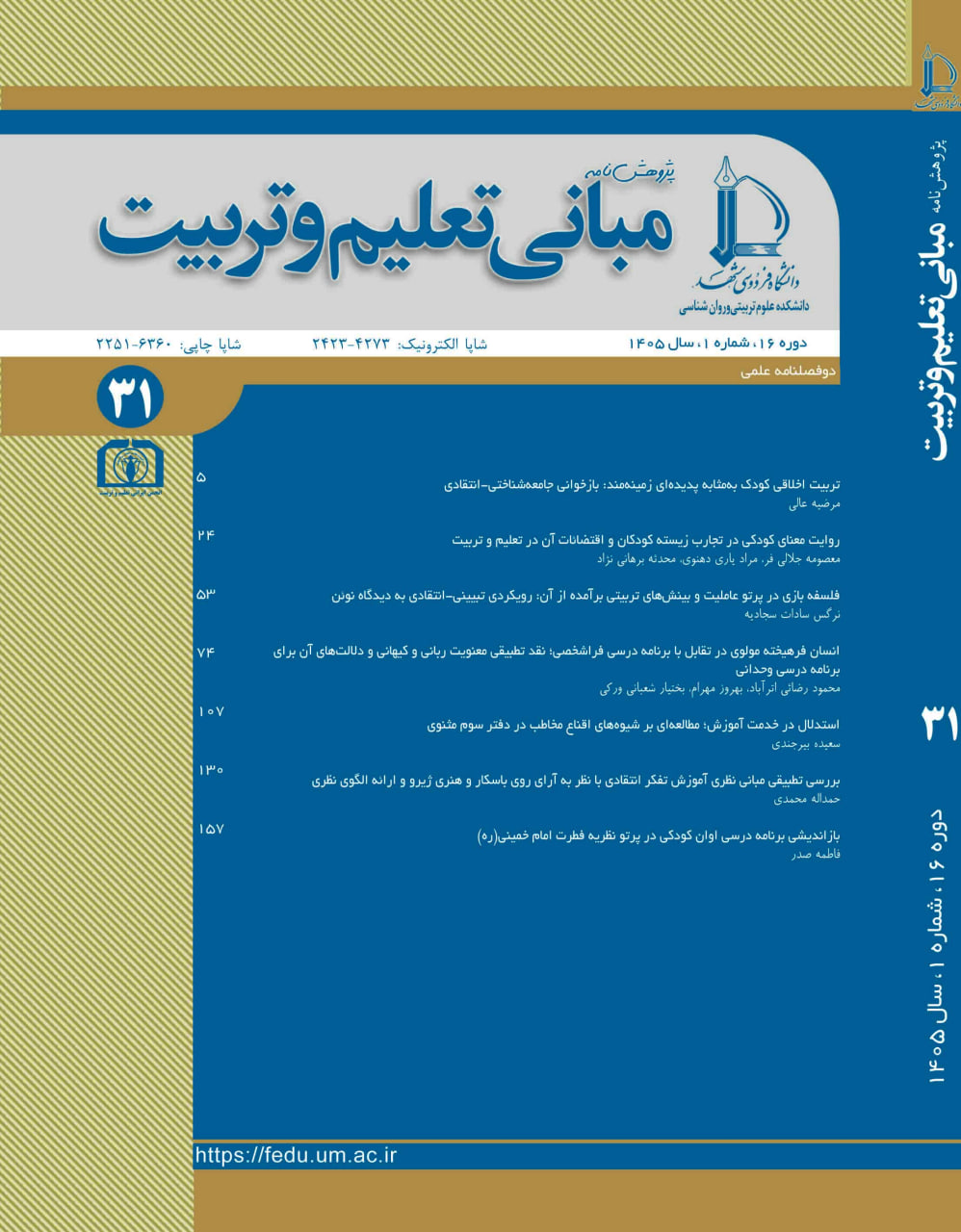
هدف این پژوهش بررسی مبانی نظری تفکر انتقادی با نظر به آرای روی باسکار و هنری ژیرو و ارائه الگویی نظری برای آن است. در این پژوهش به استفاده از روش مقایسهای جورج بردی (توصیف، تفسیر، همجواری و مقایسه- ترکیب) به تطبیق نظریات این دو متفکر پرداخته شده است. در ادامه نیز از روش استنتاجی برای ارائه الگو بر اساس مبانی نظری بیان شده، استفاده شده است و سعی شده از روش ترکیبی برای ایجاد سازواری ترکیب نوین استفاده شود. بررسیهای این پژوهش حاکی از آن است که روی باسکار در رئالیسم انتقادی خود با نظر به هستیشناسی و معرفتشناسی، مفهومی سازوار از تفکر انتقادی را فراهم میسازد که ساختارمندی، توجه به فهم تبیینی، رهاییبخشی و توجه به هستیشناسی لایهمند از ویژگیهای مهم این نوع تفکر به شمار میروند. از طرفی دیگر هنری ژیرو نیز گرچه مبانی نظری و فلسفی تفکر انتقادی توجه کمتری دارد و نظریات او دچار سیاستزدگی و شعارگونگی است، ولی از طریق پرداختن به مسائل عینی جامعه با دید انتقادی و ایجاد ارتباط بین تفکر انتقادی و تعهد اجتماعی نسبت به تغییر و سیر به سوی عدالت اجتماعی فهم قابل تاملی از تفکر انتقادی را در برنامه درسی و تدریس فراهم میآورد. در الگوی نظری این پژوهش نظریات معرفتشناختی و هستیشناختی باسکار به عنوان فرازبان استفاده شده است و در سطح اهداف و اصول آموزش تفکر انتقادی موضع فلسفی باسکار با موضع سیاسی- فرهنگی ژیرو ترکیب شده است.
Adick, C. (2018). Bereday and Hilker: origins of the ‘four steps of comparison’ model. Comparative Education, 54 (1): 35- 48. https://doi.org/10.1080/03050068.2017.1396088
Archer, M. S. (1998). Introduction: Realism in the social sciences. In: Archer, M.; Baskhar, R.; Collier, M.; Lawson, T.; Norrie, A. (Eds). Critical realism: Essential readings. Critical realism interventions. London: Routledge
Aronowitz, S. & Giroux, H. (1997) Postmodern Education (Politics, culture, & social Criticism), London: University of Minnesota Press.
Bagheri, K., Sajjadie, N., & Tavassoli, T. (2010). Approaches and methods in philosophy of education. Elmi & Farhangi Publication. (In Persian)
Bhaskar, R. (2012). The philosophy of meta-reality: Creativity, love and freedom. Routledge.
Baskhar, R. (2011). Dialectic; A Pulse of Freedom. London: Verso.
Bhaskar, R. (2009). Scientific Realism and Human Emancipation. London: Routledge.
Baskhar, R. (2008). A Realist Theory of Science. London and New York: Routledge Taylor and Francis Group.
Bhaskar, R. (1998). the possibility of naturalism: a philosophical critique of the contemporary human sciences, London: Routledge.
Baskhar, R. & Collier, A. (1998). Introduction: explanatory critique. In: Archer, M.; Baskhar, R.; Collier, M.; Lawson, T.; Norrie, A. (Eds). Critical realism: Essential readings. Critical realism interventions. London: Routledge
Bowers, C. A. (1991) Some Questions about the Anachronistic Elements in the Giroux-McLaren Theory of a Critical Pedagogy. Curriculum Inquiry, Vol. 21, No. 2, pp. 239-252
Creaven, S. (2002). The Pulse of Freedom? Bhaskar’s Dialectic and Marxism. Historical Materialism, volume 10 92): 77–141
Christodoulou, M. (2024) A Critical Realist Perspective on Teacher Education Research. In: Symeonidis, V. (Ed.). Enhancing the Value of Teacher Education Research. Boston: Brill. Pp. 42-62.
Danermark, B., Ekstrom, M., Jakobsen, L. & Karlsson, J. (2002). Explaining society: critical realism in the social sciences. London: Routledge.
Farahmanpour, R. (2010) Teaching against Consumer Capitalism in the Age of Commercialization and Corporatization of Public Education. In: Sandlin, Jenifer & McLaren, Peter. (Ed) Critical Pedagogies of Consumption. New York& London: Routledge.
Feriere, P. (2012). Pedagogy of the oppressed. New York and London: Continuum
Fisherman, D. (2010). Thinking as two: philosophy, critical thinking and community inquiry. Childhood and philosophy, 12 (6): 211-229
Foucault, M. (2015). The birth of the biopolitics. Nashre Ney Press. (In Persian)
Giroux, H. (2024). Critical Pedagogy Against the Neoliberal Agenda in Education: The Stance of Critical Educators. Journal of Underrepresented and Minority Progress, 8 (2): 1-9
Giroux, H. & Bosio, E. (2021). Critical Pedagogy and Global Citizenship Education. In Emiliano Bosio (Ed.), Conversations on Global Citizenship Education: Perspectives on Research, Teaching, and Learning in Higher Education (pp. 1-10). Routledge: New York.
Giroux, H. (2015). Democracy in Crisis, the Specter of Authoritarianism, and the Democracy in Crisis, the Specter of Authoritarianism, and the Future of Higher Education. Journal of Critical Scholarship on Higher Education and Student Higher Education and Student Affairs, 1 (1): 101-116
Giroux, H. (2005). Border Crossing: Cultural and the Politics of Education. Second Edition. New York: Routledge.
2004) Cultural Studies, Public Pedagogy, and the Responsibility of Intellectuals. Communication and Critical/Cultural Studies. 1 (1): 59-79
Giroux, H. (1994). (1994) Teachers, Public Life, and Curriculum Reform. Peabody Journal of Education, Vol. 69, No. 3, pp. 35-47
Giroux, H. (1985). Teachers as Intellectuals. Abc-Clio, Incorporated
Giroux, H. (1980 b) Critical Theory and Rationality in Citizenship Education, Curriculum Inquiry, 10, No. 4, pp. 329-
Giroux, Henry (1978) Writing and Critical thinking in Social Studies. Curriculum Inquiry. 8(4). 291-310
Gramsci, A. (1987). Prison Notebooks. Vol 1, Translated in English by Antonio Callari, Columbia University Press
Green, M.; Stangl, L.; Cope, S. (2024). A Qualitative Study and Future Research Agenda for Cultivating Critical Thinking in Culturally Diverse Postgraduate Students. Jornal of Marketing Education, https://doi.org/10.1177/02734753241295996
Jones, P. (1982). 'Organic' Intellectuals and the Generation of English Cultural Studies, Thesis Eleven, 5-6 (1):85-124
Karakoc, M. (2016). The Significance of Critical Thinking Ability in terms of Education. International Journal of Humanities and Social Science, 6 (7): 80-84
Lai, E. (2011). Critical Thinking: A Literature Review,
Li, X. & Liu, J. (2023). Validating a Critical Thinking Ability Questionnaire for EFL learners. Thinking Skills and Creativity, 51(1), 1016/j.tsc.2023.101442
Liston, D. & Zeichner, K. (1988) Critical Pedagogy and Teacher Education, Paper presented at the Annual Meeting of the American Educational Research Association (New Orleans, LA, April 5-8)
Lu, C. & Swatevacharkul, R. (2020). An Analysis of Critical Thinking from the Philosophical, Reflective, Cognitive and Cultural Perspective, English Language and Literature Studies; 10 (4): 70-78.
Ritola, J. 2021. “Philosophical Issues in Critical Thinking.” In: Oxford Research Encyclopedia of Education. New York: Oxford University Press.
Sayer, A. (2000). Realism and Social Science. London: Sage Publication
Scott, & Baskhar, R. (2015). Baskhar; A theory of education, London: Springer
B (2004) The Educational Limits of Critical Realism? Emancipation and Rational Agency in the Compulsory Years of Schooling. 2004 IACR Conference (Cambridge, UK).
Wilson, M., Greenhill, A. (2004). Theory and Action for Emancipation: Elements of a Critical Realist Approach. In: Kaplan, B., Truex, D.P., Wastell, D., Wood-Harper, A.T., DeGross, J.I. (eds) Information Systems Research. IFIP International Federation for Information Processing, vol 143. Springer, Boston, MA. https://doi.org/10.1007/1-4020-8095-6_42
White, C. (2006). Realism, Science and Emancipation. In: Dean, K.; Joseph, J.; Robert, J.; White, C. (Eds.). Realism, Philosophy and Social Science, McMillan: Palgrave.
Wilson, M. & Greenhill, A. (2004). Theory and action for emancipation: Elements of a Critical Realist approach. Information system research, http://dx.doi.org/10.1007/1-4020-8095-6_42
Zibakalam, F. & Mohammadi, H. (2014). A Comparative Study of Critical Thinking from the Viewpoint of Robert Ennis and Henry Giroux Considering Its Application for the Modification of Teacher Training System. Applied Psychological Research Quarterly, 5 (3): 19-38
محمدی، حمداله. (1405). بررسی تطبیقی مبانی نظری آموزش تفکر انتقادی با نظر به آرای روی باسکار و هنری ژیرو و ارائه الگوی نظری. پژوهش نامه مبانی تعلیم و تربیت، 16(1)، 130–156. https://doi.org/10.22067/fedu.2026.96294.1478
MLA
محمدی، حمداله. "بررسی تطبیقی مبانی نظری آموزش تفکر انتقادی با نظر به آرای روی باسکار و هنری ژیرو و ارائه الگوی نظری"، پژوهش نامه مبانی تعلیم و تربیت، 16، 1، 1405، 130–156. doi: 10.22067/fedu.2026.96294.1478
HARVARD
محمدی، حمداله. (1405). 'بررسی تطبیقی مبانی نظری آموزش تفکر انتقادی با نظر به آرای روی باسکار و هنری ژیرو و ارائه الگوی نظری'، پژوهش نامه مبانی تعلیم و تربیت، 16(1), pp. 130–156. doi: 10.22067/fedu.2026.96294.1478
CHICAGO
محمدی، حمداله، "بررسی تطبیقی مبانی نظری آموزش تفکر انتقادی با نظر به آرای روی باسکار و هنری ژیرو و ارائه الگوی نظری." پژوهش نامه مبانی تعلیم و تربیت، 16 1 (1405): 130–156, doi: 10.22067/fedu.2026.96294.1478
VANCOUVER
محمدی حمداله. بررسی تطبیقی مبانی نظری آموزش تفکر انتقادی با نظر به آرای روی باسکار و هنری ژیرو و ارائه الگوی نظری. مبانی تعلیم و تربیت. 1405;16(1):130–156. doi: 10.22067/fedu.2026.96294.1478